
About
Root Canal Treatment: The Complete Guide to Saving Your Natural Teeth in 2026
You’re sitting in a waiting room, half convinced you should just have the tooth pulled. The pain has been waking you up at night, your jaw is tender, and someone in your family already told you that a root canal is “the worst thing you’ll ever sit through.” So now you’re here, searching for real answers instead of horror stories.
Here’s what most articles won’t tell you upfront: the stories are wrong. Or at the very least, they’re about a version of this procedure that hasn’t existed for a very long time.
Modern root canal treatment is precise, predictable, and with today’s anaesthesia and techniques genuinely comfortable for the overwhelming majority of patients. More importantly, it does something that no extraction can: it keeps your natural tooth exactly where it belongs. The team at Dr. Teeth Radhe Orthodontic and Multi-Specialty Dental Care put this guide together because the same questions come up again and again in the consultation chair, and patients deserve straightforward answers rather than vague reassurances.
What Is Root Canal Treatment, Actually?
Every tooth has a soft inner layer called the pulp a network of nerves, blood vessels, and connective tissue that helped the tooth develop during childhood. Once a tooth is fully formed, that pulp isn’t strictly necessary for the tooth to survive, because the surrounding tissue can continue nourishing it.
The problem arises when bacteria reach this pulp through deep decay, a crack, a chip, or a failed old restoration. Once infected, the pulp can’t heal on its own. The infection builds pressure inside the tooth (which is what causes that distinctive, throbbing pain), and if left alone, it spreads: to the root tip, into the jawbone, and sometimes beyond.
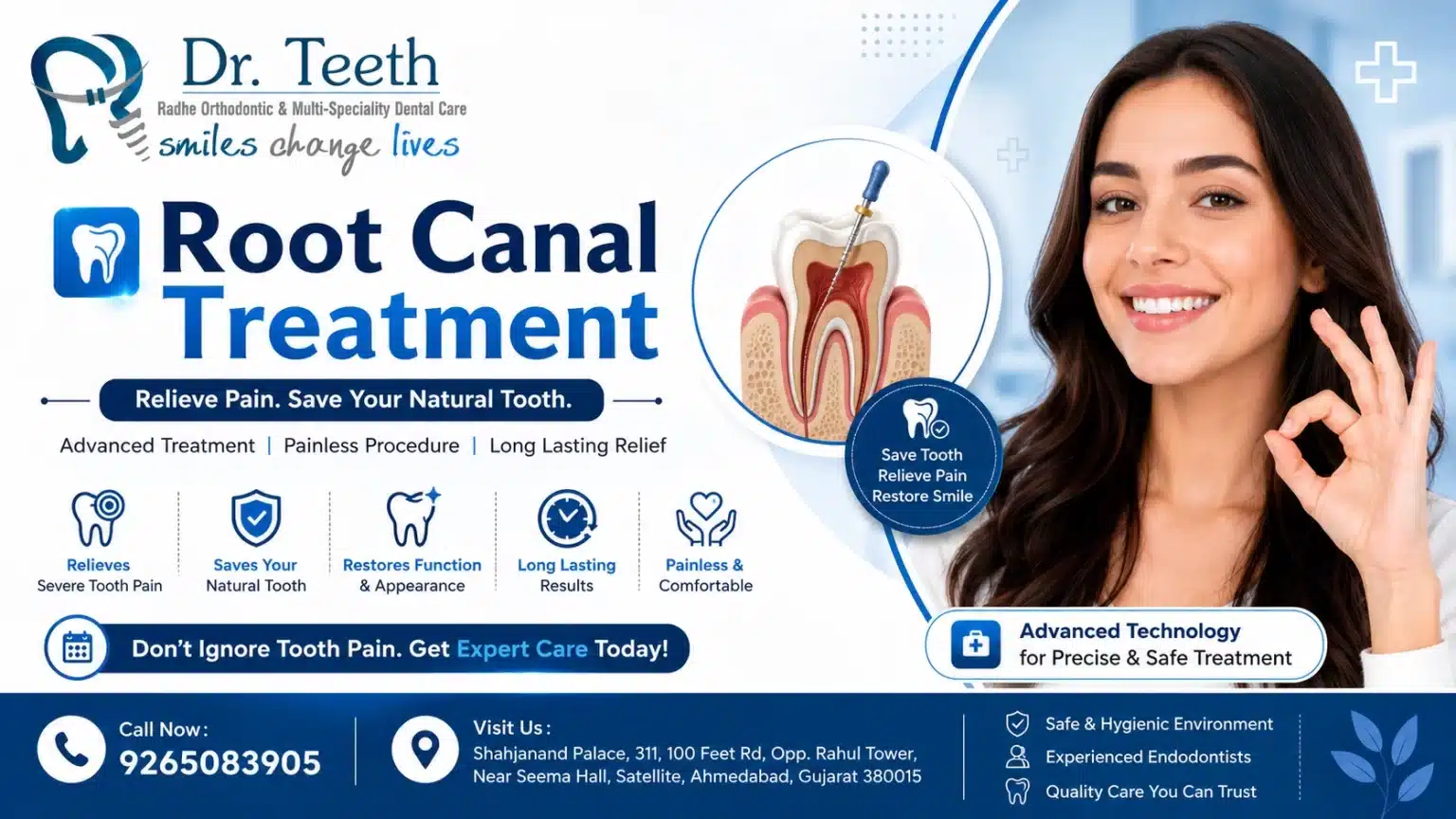
Root canal treatment removes the infected pulp, thoroughly cleans and shapes the canals inside the root, and seals everything with a biocompatible material. The tooth stays. The infection goes. A crown placed afterward restores the tooth’s full function and most patients can’t tell the difference between a properly restored treated tooth and any other tooth in their mouth.
It’s worth saying plainly: a tooth root canal doesn’t hollow out your tooth or make it fragile. It removes a specific source of infection and gives the tooth the best possible chance of lasting for decades.
Root Canal Symptoms: How Do You Know You Need One?
Not every infected tooth announces itself with unbearable pain. Some cases are discovered through routine X rays before they produce any discomfort at all. But the following root canal symptoms are signals worth taking seriously rather than waiting out:
A persistent, deep ache in a specific tooth especially one that worsens at night or when you lie down
Sensitivity to hot or cold that lingers long after the source is removed (a few seconds is normal; a few minutes is not)
Sharp pain when biting or applying pressure to the tooth
Swelling or tenderness in the gum tissue around the tooth
A small pimple-like bump on the gum called a sinus tract that may come and go
Darkening or discolouration of a single tooth compared to its neighbours
A tooth that previously had a large filling or crown and has started aching again
Any one of these on its own is worth a prompt dental visit. Several together especially pain combined with swelling mean you should call the same day. Waiting doesn’t make an infected tooth better; it almost always makes it worse.
Keywords
Root Canal Treatment